









































































There is nothing like a really great tree. Those that have stood the test of time have such a remarkable spirit and man, if trees could talk…. And as for the title, I’m not kidding: have your ever hugged a tree? Try it – it’s really amazing and you don’t have to be a treehugger to feel all that energy. So I thought I’d explore some of the amazing trees around the world – ones on my to do list and ones I have seen.
I’ll refrain from commenting on the world’s oldest tree here – because you can’t go and see it. There are several that claim the title – from Methuselah hidden away in California to a spruce in Sweden. Let’s just enjoy what we have, and try to not cut down as many as we plant, ok? 
Giant Sequoias – Northern California
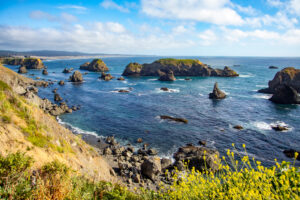
The giant sequoias of Northern California have to top my list as some of the coolest and most awesome of the trees around the world. I of course went in with the visions of those trees you can drive through they’re so large, and actually, they’re even taller than I imagined. The trees in Santa Cruz National Park are lovely, and this whole area has some lovely viewpoints of the ocean, as well as the scenic drives along the Pacific Coast Highway. And sequoia is the only word in the English that uses all the vowels. What’s not to like?
Ta Prohm – Siem Reap, Cambodia
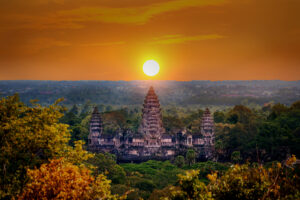
This is probably one of the most famous trees around the world – Ta Prohm, one of the beautiful temples in the Angkor Wat complex in Cambodia. What an incredible and stunning place; reflecting back on my visit, I am still speechless at the size and sheer scale of the city that once stood here. These trees actually have helped preserve the temples; without these roots the walls would have likely fallen. So we’ll be thankful, and leave them – removing them would destroy the temple.
“The fig tree is the ruler of Angkor, over the palaces and over the temples which it has patiently pried apart, everywhere it unfolds its smooth pale branches, like the coils of a serpent, and its dome of foliage.”
– George Coedes, 1943
Divi-Divi Trees, Aruba
We’ve talked about some of the great things to do in Aruba, but one of most unusual is a driving tour to check out some of the divi-divis, the strangest of the trees around the world. That’s because it’s bent sideways: Aruba is a real paradise because of its tradewinds, meaning it isn’t so hot (when you find a spot without a breeze, you’ll soon see why). But these trees aren’t strong enough to stand up to Mother Nature’s forces, so they just go with the flow – literally. You’ll find them in all sorts of twisty shapes and turns.
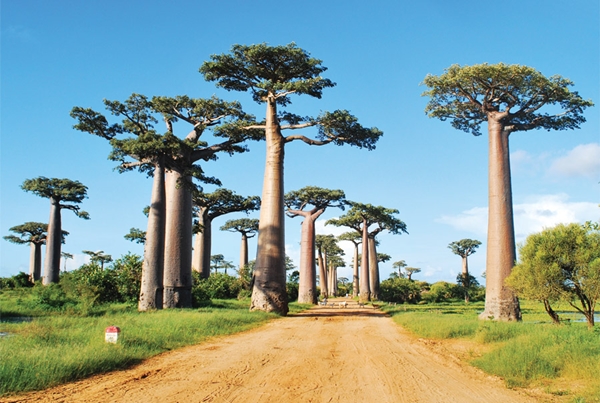
Baobab Trees of Madagascar
There are plenty of reasons to go to Madagascar, the island nation off the coast of eastern Africa, and the unusual Baobab tree is one of them. The fruit packs a vitamin-powered and is used to make cream of tartar. There are several species of this tree; the iconic ones shown are only found on Madagascar and are endangered.
Montezuma Cypress, Mexico

They say this scary tree has one of the “stoutest trunks” of all the trees around the world. (I’ve always wanted to use stoutest in a sentence.) It’s in Santa María del Tule, a town in Oaxaca. If you wrapped a piece of string around the girth of the tree, that string would have to be 30 feet long. You can’t hug this tree, unfortunately – not only is it too big, but there is a fence in your way.
The Tree of Life, Bahrain

One of the most isolated trees around the world, this lonely tree stands in the hash desert of Bahrain. It’s called the tree of life because it seems to magically grow here despite the lack of a proper water source. Little is known about it – it’s though to be a mesquite tree, but no one seems to have a certain opinion.
The Wonderboom, Pretoria, South Africa
This sprawling mass is know as the Wonderboom, one of the most famous trees around the world and in South Africa. It’s part of of the Wonderboom Nature Reserve, so you’ll for sure have to pay a visit for the great views and hikes if you stop in Pretoria during your next South African adventure. Wonderboom means ‘miracle tree’ or or ‘wonder tree’ and it is called that because the centuries old tree in the centre is now surrounded by several child trees which grew out of the low hanging branches of the tree.
Major Oak, Sherwood Forest, England
Major Oak in Sherwood Forest, Nottinghamshire, is the most visited tree in Great Britain. The oak is a well known tourist attraction because it is said that Robin Hood and his band of merry men used this as their base camp. Today, the only thing hanging out around the tree is the support mechanisms keeping the tree from collapse, put in place by the Victorians.
Red Forest, Chernobyl, Ukraine
Believe it or not, the wildlife around Chernobyl is thriving despite the effects of radioactive fallout. Some say this is due to the lack of human involvement, but it seems Mother Nature has her way even in adversity. The forest around the old plant is called the Red Forest because many of the trees turned this colour after the radioactive fallout. The contaminated trees were bulldozed and buried, covered with sand and new trees planted. These trees, of course, are pulling contaminated nutrients from their roots, so there are stories of bizarre and unusual tree mutations. You can visit Chernobyl, but do arrange for a guided visit – this isn’t place to just wander around at your leisure.
The Survivor Tree, Oklahoma City USA

Of all the trees in the USA, this is the most poignant one I’ve ever seen. After the terrorist bombing of a building in downtown Oklahoma City, rubble and destruction was scattered for miles, yet this lonely little tree still stood standing, just steps away from the blast site. It was included in the memorial site plans, and is truly a testament to Mother Nature’s strength.
The Witch Tree, Lake Superior, Minnesota

It’s hard to believe that in such a hash, blustery environment that a tree could survive for so many years – perched on a rock out into the lake, no less. However, this tree has been making a name for itself for hundreds of years – it was mentioned by French explorers, and the indigenous Ojibwe tribes who once roamed these lands considered it the most sacred of the trees around the world. Today you can only visit with an Ojibwe guide due to fears of vandalism.
The Curtain Fig, North Queensland, Australia
This breathtaking beauty is another one of the incredible sights of Queensland – just when you thought those eye-watering beaches were enough, you get one of the coolest trees around the world. Photos don’t do it justice, as the tangles of vines drape down to create not just a curtain, but almost a wall of tree. It’s incredible and must-see.
Lone Cypress, Monterey, California USA

It seems that California has the monopoly for the coolest trees around the world. The Lone Cypress is another, which you can find while enjoying the ’13 mile drive’, a scenic tourist attraction that takes you around some of Monterey peninsulas most stunning sights, from Pebble Beach to this gorgeous tree, hanging out along the coast enjoying the view. This is a great area to spend a weekend enjoying the buzzing atmosphere and there are plenty of things to see and do.
The Dragon Tree, Tenerife

Perhaps you thought Tenerife was full of tawdy tourist resorts, but there are a few highlights worth mentioning. One is the Dragon Tree, which is one of the most unusual trees around the world – nobody know how old it is, and estimates range from 800 to 3,000 years. It’s a huge tourist attraction in the town of Icod, and you have to pay to get the good view. The tree has a fan to prevent damp, and a hidden metal structure to support it. These types of trees exude a red resin, which in ancient times was known as dragon’s blood, hence the name.
Photo Credits: richardmasoner, jurvetson, Wikimedia Commons, plizzba, hmerinomx, solvo, Wikimedia Commons, charnewcomb, Tim Suess, artlung, plaeontour, zemistor, cinetech
No Comments